Although some of you in the UK and the US may have been plagued by small sugar-crazed bandits in fancy dress on Saturday night, Hallowe’en is actually tomorrow, 31st October. Otherwise known as All Hallows Eve, or All Saints Eve (Toussaint in French), it is the night when the dead are said to rise and wreak havoc on the living, and so must be appeased with gifts.
In Poland everyone goes to the cemetery and places candles in coloured jars on the graves. Shortly after nightfall the cemeteries look like discothèques with flickering coloured lights and a constant flow of people. It’s all rather convivial and not in the least scary. The Roma gypsies congregate on the graves of their departed with guitars and sing songs, some even have picnics. The cemetery is the place to go in Poland on All Saints Eve or Wszystkych Świętach as it is called in Polish. And if you can say that, you’re sober enough to drive home. On 1st November, All Saints Day, the roads of Poland are gridlocked with people driving all over the country with a carboot full of votive candles (which are sold in bulk packs in the supermarkets) visiting their dead relatives wherever they may be. I refer you to my Hallowe’en piece from 2001, which will show you how seriously Harold took it.
In reality of course, All Saints or Hallowe’en, whatever you choose to call it, is a festival to mark the beginning of winter, and so it is fitting that it should have dark overtones, to get us in the mood for the long cold winter months. It now coincides nicely with the weekend of putting the clocks back. Summer is officially over, and all is safely gathered in. I rather like these reminders of the changes in the seasons. The way global warming is going, soon it will be the only way we’ll be able to keep track of the months - I still haven’t felt the need to put any heating on, it is unnaturally warm for the time of year here in Brussels.
Of course Harold is the dear departed now, and I am afraid I cannot visit his final resting place as he is buried somewhere in West Africa inside a giant beer bottle.  His grieving subjects pour a libation of Star beer on his grave every Friday evening, so I have sent them a few quid by Western Union to buy him two pints of lager and a packet of crisps from me. I hope he doesn’t come back to haunt me. I avoid wearing red to bed, on the advice of Guyana-Gyal, as it reportedly brings the dead to life in a way most graphically described by the Rolling Stones in their seminal work “Start me up”. Harold thought the marital bed was a place for listening to the footie on Radio 5 Live whilst eating crisps.
Witchcraft is taken very seriously in West Africa, as you will see from the local press. Godwin, our faithful driver, despite being a devout Christian, was a firm believer in the black arts. He told me once about a woman who had reportedly turned into a bird in front of an entire village. “Godwin,” I asked him, “Did you see this with your own eyes?” Godwin looked a bit sheepish. “No, Madame,” he replied. “Well how do you know it happened?” I insisted. Godwin looked shocked. “Madame, it was in de newspaper!” he protested. Their faith in the veracity of the press is as unshakeable as their faith in the Church, witchcraft and the IMF. Touching. But not helping much.
I suspect I have witchy tendencies myself. I feel responsible for the death of Princess Diana, as the night before her untimely demise I made a throwaway remark along the lines of “I wish that woman would just disappear.” When I saw how quickly my wish had been granted, I started wishing very hard that Harold would turn into George Clooney, but I think I must have used up all my witchiness on Diana, as he never did.
 I have finally finished the first volume of Philip Pullmann’s trilogy “His Dark Materials”, and am quite hooked. The book features a rather fetching witch by the name of Serafina Pekkala, who is just the sort of witch you’d like to be able to call up in a crisis. Samantha from “Bewitched” was a delightful modern witch. But my favourite witch of all time is the Good Witch of the East in The Wizard of Oz, who gave Dorothy the Ruby Slippers. Any friend of Dorothy is a friend of mine.
 De Skieven Architek is a term used by the people of the Marolles about the man who designed and built the Palais de Justice, or law courts. It translates as “that damn architect”, or perhaps something a bit stronger. The damn architect in question was Baron Poelaert, yes he who lends his name to the wide open and generally waste of space in front of his creation, the Palais de Justice. It took 17 years to build, and required 1,000 families to be forcibly evicted to make space for its bulk. They did not go quietly, and there were riots and even a suicide before they were persuaded to relocate. It was the largest building in Europe during the 19th century – 4,000 square metres larger than St Peter’s in Rome – and dominates the city for miles around with its grandiose cupola.
Poelaert died in a lunatic asylum in 1879 and never lived to see his creation completed. Legend has it that a witch from the Marolles district cursed him and finished him off with a form of Belgian voodoo. But before he died, he also built several more edifices, including St Catherine’s church, and a fire station on Hoogstraat, which was recently converted into a restaurant. And guess what it’s called? “De Skieven Architek” of course.  It’s a very Flemish restaurant, and the schoolmistressy waitresses greet you with a firm “Goededag” (which always sounds to my untrained ear like Hooeydaah). The restaurant serves typical Flem dishes like carbonnade and rabbit, but also has an impressive list of beers, both draught and bottled, some of which are brewed by the restaurant’s own off-premises microbrewery and can be bought to take out. Some of the beers on offer had an alc.vol. content of 10.8% - I am not sure if these figures mean the same thing all over Europe, but that’s almost the alcoholic content of wine. No wonder it is served in small glasses here. The“Witte Brigittine” wheat beer was refreshing: cloudy and not very gassy, with a slightly fruity taste. I only had the one, though.
After a leisurely perusal of the menu which includes a good deal of history about the area and the building in French, Flemish and English, I ordered authentic Brussels “stoemp” which, for the uninitiated, is a sort of potato and vegetable mash involving potatoes, carrots, onions and whatever other vegetable is lying about in the larder that day. “Stoemp” is probably a fairly accurate description of the culinary process used to prepare it. It is fairly basic peasant fodder, and the vegetables are not so much mashed as just sort of stamped on with hobnailed boots. They are served piping hot with a sausage and a slice of belly pork, and hits the spot on a chilly October Sunday after a morning tramping round the flea market. I quietly congratulated myself when I spotted two hulking great Flemish market boys tucking in to the same thing at the next table. I just love to know I’ve got the local culture right.
 The Architek is a pleasant restaurant, the high ceilinged main room hung with paintings. Only one complaint – it costs 50 cents to spend a penny. This is a subject that gets me into a bate, the number of restaurants in Brussels which charge customers to use the facilities. The loo was admittedly spotless. But I am a customer, for heaven’s sake. It’s their beer I’m getting rid of. It’s simply not on.
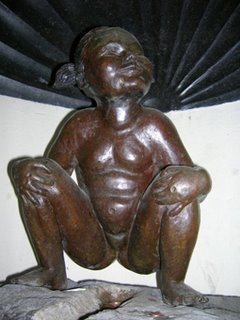
Although you won't find me following the example of the Jannekin Pis.
 Brussels is not so much a city as a collection of villages, which I am still discovering. Long-time Brussels denizen Lolo La Clope recently introduced me to St Boniface, one of this town’s better-kept secrets. It’s in Ixelles, tucked away between the Chaussée d’Ixelles and Matongé, the African district. Matongé is Little Kinshasa, with its wig shops, wax cloth emporia and groceries selling plantain and yam. St Boniface is one street removed from Matongé, but turning off the Rue de Wavre up Rue Francart takes you into a different world. Out of Africa, you might say.
The three or four streets which make up the district sit in the shadow of the beautiful Gothic church of St Boniface. There are about 15 cafés and restaurants within the 500 metres or so radius of the church. The most popular and well-known café is L’Ultime Atome (geddit?) (it’s a French pun) whose tables cover the pavement across the corner of Rue St Boniface and Rue Ernest Solvay. The range of eateries goes from the very classic French Le St Boniface, via some ultra trendy Asian fusion places Le Deuxième Element and Citizen, trendy Italian pizza-pasta joint Mano a Mano, nouveau-Belge Belgo (any relation to the one in Covent Garden? not sure), chic minimalist wine bar Vedett, sushi bar Hana, and Greek taverna Le Syrtaki, to the downright tropical. Around the world in 80,000 calories.
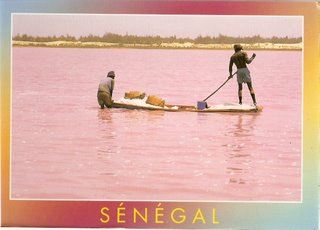 Matongé spills over into St Boniface with Senegalese restaurants l’Ile de Gorée and Le Port d’Attache, and the über-trendy Au Bout du Monde where you can eat smoked antelope or boar and the interior is scattered with zebra skins and elephant heads. If Vi Hornblower went in there dressed in her trademark leopardskin print, she'd disappear into the wallpaper. Not for vegetarians, but très à la mode. I applaud this upwardly mobile ethnicity, and where West Africa is concerned, Senegal is as good as it gets. Even Peter Gabriel has a place near Dakar. On rue Ernest Solvay is atmospheric Moroccan restaurant Le Vent du Sud with its dimly-lit cushioned and lanterned interior, which Lolo rates as probably the best couscous in Brussels.
 We dined at Au Vieux Bruxelles – Chez Camille at 35 rue St Boniface, which is a traditional old Brussels brasserie a bit like Chez Léon, but without the tourists. All the usual suspects on the menu – mussels, bien sur, and carbonnade, waterzooi, bunny, etc. etc. but also a good selection of fish and some slightly more elaborate dishes. Lolo had poulet a l'estragon. which was a more than generous portion, half a chicken I’d say. I had an old Flemish favourite, carbonnades à la Gueuze - do you get the irony of a Flemish dish with a French name? No? I guess that means I've been in Belgium too long. It is basically chunks of beef stewed in beer and in some less scrupulous places not much more than a tarted up beef casserole. However, I had a feeling it might be a bit special here, and I wasn’t wrong – the beef chunks were served in their own individual cooking pot, and were tender and succulent, the beer gravy was thick and unctuous, and you could actually taste the Gueuze beer, which is slightly sweet à la Newcastle Brown. Both dishes were served with chips on a side plate. (I’m sorry, Pat. Baby new potatoes would have been more fitting. But they were crispy and golden and delicious. And - oh hang protocol – I like chips.) With a bottle of Cotes du Rhone at 23 euros, and a half bottle of water, no starter, no dessert, and no coffee, the bill came to a mere 50 euros for two. The restaurant was full, and the friendly waitress in her spotless white apron chatted away like your favourite aunty about the non-smoking law to be introduced on 1st January. She had been a 30-a-day girl, she told us, but was now using patches to help her give up the weed. "And do you feel better now?" asked Lolo hopefully, looking for encouragement to pack in the fags. "Not at all. I feel worse than I've ever felt in my life. Can't sleep, can't eat, headaches, stomach cramps ...." Lolo's face dropped, as she reached for her pack of Camel.
The atmosphere was very pleasant and cosy, homey I think our friends across the pond would say. The restaurant is family-friendly and the powder rooms are spotless. And free. Always important. So in future I will avoid taking my guests through the hordes on the rue des Bouchers, and bring them to St Boniface. Then I’ll walk them to the metro through Matongé, just for a laugh.
 I arrived in Brussels just over a year ago en catastrophe and in reduced circumstances, due to having had to hand over every last stick of furniture to Nana Godsbrain Boateng Kwaku XVI, The Ya Naa of Mbongoland (West), to pay for Harold’s funeral. In West Africa coffins are custom-made to suit the personality of the deceased, and a bottle of Star beer was agreed to be the appropriate receptacle to carry him into the next world, since it played such a key role in carrying him out of this one. It wasn’t cheap, I can tell you, but I’m sure you’ll agree that he certainly went out in style. I dressed him in his favourite beige cardigan and dabbed at my eye as he was despatched to the care of the great deity Manatcanda, while the choir of the Seventh Day Redemption Chapel sang the theme from Match of the Day.
With African tribal ceremonies the entire village has to be invited, they invite their friends and relatives, who in turn invite their friends and relatives, and they all have to be fed, watered and entertained, at great expense. It would have been cheaper to fly him back in a private jet, but his last wish was to be buried among his “subjects”. (He was suffering from delusions of grandeur by the end). I tried e-mailing friends all over the world for their bank account numbers in order to transfer a large amount of money which was blocked in my Swiss bank account, but nobody seemed willing to help. So, after an exhausting 5-day wailing period, I had to bake four hundred thousand vol-au-vents and distribute alms to the poor - who I then joined, after I had no more alms left to distribute. You could say I was almless. I left Mbongoland by dugout canoe with two Louis Vuitton suitcases, and managed to flag down a Liberian cargo ship en route which gave me a lift to Antwerp, for an extortionate price. But I did get to sit at the Captain’s table every night. In his cabin, mind you.
On arriving in Brussels with only a few cowrie shells to my name, I was obliged to rent a poky maid’s room which was little bigger than a shoebox, in which to rest my weary décolleté. Even though I had little more in my wardrobe than a Chanel suit and a string of pearls, it was hardly a fitting abode for a Grande Dame of my calibre. However, it was situated in a leafy suburb somewhat reminiscent of Cheam which shared the initials of my last name, and thus felt destined for me. I am supremely adaptable, and acquired a pair of green wellies and a shopping trolley in order to fit in with the locals. I soon became a familiar sight at the local Sunday market in my trademark colourful robes  and toffee wrapper headdress fashioned à la Scarlett O’Hara from batik tablecloths. With a darker shade of foundation, nobody suspected I was not a genuine Mbongo market lady selling lace doilies and teacakes. I rather missed Mbongoland at first, but now I’ve moved to a neighbourhood which feels just like home, and I can call out a cheery “Woyayah!” to my neighbours in the morning. I still don’t have room for more than one servant, but it’s a slight improvement. Fear not, the south will rise again.
A large amount of money is still blocked in my Swiss bank account. If you would like to send me your bank details, I would certainly make it worth your while.
Incidentally, you should know that North Korea is not the only nuclear proliferator we have to worry about.
 The excitement of the Labour Party Conference (yawn) might have deflected your attention from the international news. There has been the odd rumbling here and there. Demonstrations in Hungary. And the most frightfully polite coup d’etat in Thailand. Now I have experienced the odd coup in Africa, when you are confined to quarters for days until you’ve found out who’s in charge. Sometimes they were so frequent I hadn’t even found out the name of the new supremo before he was deposed by someone else. But in Thailand they’re so terribly nice, it could have been planned in a tea room in Surrey. The Generals appeared on television and said they were most frightfully sorry, they really didn’t want to cause any alarm, but things had got a little … well, distasteful, with the corruption and so on, and it was sincerely hoped this slight interruption of democratic rule, although necessary, would not last long, measures were already being taken to re-establish the electoral process as soon as humanly possible, so please bear with us ladies and gentlemen, normal service will be resumed as soon as possible. Not a drop of blood was spilt. So they say, anyway. The outgoing Prime Minister was kindly invited to accompany the officers
  to army headquarters. Such lovely manners. Sandhurst trained, doncha know. The soldiers had obviously had been drilled in calm and effective crowd management by the Edinburgh Polis, and you would have thought they were simply managing a Monday morning diversion at Hanger Lane giratory system. The top echelons togged up in their best dress whites with all their gongs nice and shiny, and paid allegiance to the King, who was obviously in on it from the beginning.
I do hope our Top Brass were watching. If there are not some changes by next year we might need to resort to something similar in England. With our usual sang-froid and good manners, we will probably call it something else (much as we don’t have anything as sordid as “corruption”,  we have “irregularities” instead). And it would be done on a bank holiday, so as to cause the minimum possible disruption. It would probably merit a couple of inches on page 2 of The Times. The Sun’s front page would trumpet “OWZAT !!” or something equally irreverent. Today's news indicated that our boys in the sandpit are getting a little impatient and would like to come home. It wouldn't take more than a couple of quick e-mail exchanges with Her Majesty, and Bob's your uncle. Regime change starts at home.
BBC’s new series Robin Hood is quite addictive from five minutes into the first episode, even though we all know the story, there is always a new spin to be added. Did I detect the occasional topical reference, such as “standing shoulder to shoulder with Rome” ? Are we to read into this an incitement to rise up against Bad King Tony? Tune in next Saturday, UK viewers, and in the meantime keep an eye out for tanks rumbling down your street. Our boys would appreciate a nice cup of tea while they're doing the Junta.

 Although some of you in the UK and the US may have been plagued by small sugar-crazed bandits in fancy dress on Saturday night, Hallowe’en is actually tomorrow, 31st October. Otherwise known as All Hallows Eve, or All Saints Eve (Toussaint in French), it is the night when the dead are said to rise and wreak havoc on the living, and so must be appeased with gifts.
 His grieving subjects pour a libation of Star beer on his grave every Friday evening, so I have sent them a few quid by Western Union to buy him two pints of lager and a packet of crisps from me. I hope he doesn’t come back to haunt me. I avoid wearing red to bed, on the advice of Guyana-Gyal, as it reportedly brings the dead to life in a way most graphically described by the Rolling Stones in their seminal work “Start me up”. Harold thought the marital bed was a place for listening to the footie on Radio 5 Live whilst eating crisps.
  I have finally finished the first volume of Philip Pullmann’s trilogy “His Dark Materials”, and am quite hooked. The book features a rather fetching witch by the name of Serafina Pekkala, who is just the sort of witch you’d like to be able to call up in a crisis. Samantha from “Bewitched” was a delightful modern witch. But my favourite witch of all time is the Good Witch of the East in The Wizard of Oz, who gave Dorothy the Ruby Slippers. Any friend of Dorothy is a friend of mine.