Thursday, March 30

A Load of Balls

Cynthia and Angus were in town for a Harold Pinter retrospective (Cynthia used to edit his long pauses). I met up with them in Café de BXL on the Grand’ Place where they were several glasses into the beer-tasting: five varieties of draught Belgian beer for 9 euros. They are served in small brandy glasses on a wooden platter with some cheese cubes, each glass containing 12.5 centilitres, so at £6 a pint this bar have hit on a sure fire moneymaker. However, it is a very good way of sampling Belgian beers without ending up flat on your back (although it gets you off to a good start). You start with a fairly anodine lager of the Leffe variety, and move on through a Hooegaarden type cloudy wheat beer called a Blanche de Bruges, to a very tasty dark Grimbergen then progress to a fairly strong amber-coloured Ciney, finishing up with a Kriek framboise for dessert. It’s only just over a pint, but we were certainly feeling nice and fuzzy round the edges by the time we left.
We paid the obligatory homage to the Mannequin Pis, who for the record was wearing his carnival frock. We amused ourselves by thinking up names for him. Yes, of course it had to be Free Willy. We were obliged to repair to a hostelry for some strong coffee if we were going to go the distance. Le Cirio on Place de la Bourse is an art-deco treasure, very popular with old dears (even older than us) who were getting gently hammered on “half en half”. We all had double expressos, as the beer-tasting had definitely left us slightly the worse for wear.

After a bit of a feet-up at their quite posh hotel, the Renaissance on Rue de Parnasse near the EP (very good weekend deals available) we headed for the Louise area and Brussels’ answer to Little Italy. Il Trulli on rue Jourdan is named after a kind of thatched hut where Italian shepherds have nocturnal trysts with their favourite sheep. The restaurant is elegant and tables are nicely spaced out so your conversations are not overheard. Must remember that next time I’m out with Vi. The menu is fairly fishy, and our meals were all delicious. The names of the dishes were so long that if I go into detail we’ll be here all night. The wine list was even longer than the names of the dishes. It was quite over the top, weighing in at about 35 pages and listed hundreds of Italian wines, by region.

The Ladies Room is extremely elegant, and includes one of those contraptions which makes the loo seat go round in a wobbly circle while being disinfected. When Cynthia had finally recovered her composure, I had to gently explain that you are not supposed to sit on the seat while this is going on.

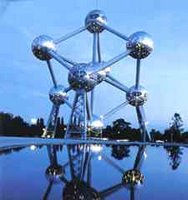
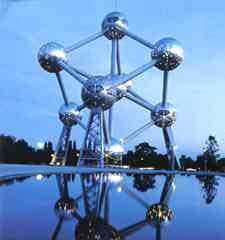
The next day I took them to the newly refurbished Atomium. Cynthia and I stood at its base and admired the big shiny balls for some time. It would have been churlish not to go inside and we wound our way from one sphere to another, feeling like characters in an episode of Dr Who. Angus, who is frightfullly clever, if a bit mad, pointed out that the Atomium is in fact a cube stood on one corner. And there was me thinking it was just a load of balls.

After a snifter at the Café Metropole on place De Brouckère, where it was warm enough to sit outside and do some people-watching, Angus announced that he was hungry again. We had to stop at a waffle van and stuff a gaufre au chocolat down him to keep him quiet.

In the evening we headed to Chez Léon, that most Bruxellois of brasseries. The food is always reliable, especially if you like mussels, but I love to sit and watch the manageress in action. Madame is always immaculately coiffed and smiling serenely, but presides over the maze-like restaurant with a gimlet eye and total control. She knows exactly who’s had what and which cutlery they used. A woman after my own heart. Angus had mussels in white wine sauce, Cynthia had sole, and I had salmon. All dishes were simple, fresh and beautifully cooked. And eaten with the correct cutlery.

We finished the evening with digestifs in Le Roy d’Espagne on the Grand’ Place, that peculiar pub where the lamps have pigs’ bladders hanging off them. I didn’t dare ask why. Angus, who of course was hungry again, had a Dame Blanche. With big shiny balls squeezed between a Blonde de Bruges and a Dame Blanche, I think most chaps would call that a good weekend.
Somewhere for the Weekend


My new gentleman friend, Baron Heinrich von Fuchs-Langezeit, proposed a weekend break. It would have been a romantic gesture, had he not let slip that he had a golfing appointment with a couple of old mates from Wuppertal. Oh well, I thought, beggars can't be choosers. We flew to Málaga from Brussels on Virgin Express for 220 euros. The two and a half hour flight was uneventful, just remember to take your own sandwiches! Or pay 4 euros for a soggy ham roll.

Marbella, 45 minutes drive from Málaga, is extremely swanky, and if you can afford to stay there, it’s really very pleasant. You really get a much better class of ghastly tourist there. We dined in a delightful courtyard restaurant near Plaza de las Naranjas, which is more or less the town square of Marbella. Thankfully the designer shops close early there, as my plastic would have gone into meltdown. Nearby Puerto Banus is where the mega-rich park their yachts while they go to have their gold cards polished. Heinrich marched around the harbour sporting his nautical cap and cravat, and staring out to sea through his one good eye. As we sat at a harbourside cafe having a well-earned libation, I thought I heard him say "Sink the Bismarck", but it turned out to be "I zink ze beer's muck". His Prussian accent is very attractive, but occasionally quite impenetrable.

Mijas is a former Arab fortress and beautiful “pueblo blanco” clinging to the hills above Fuengirola. Although it can be overrun with tourists in high season, it is a delightful little place with a shrine to the Virgen de la Pena, a sort of large Barbie doll with an impressive wardrobe who lives in a grotto and is paraded through the town occasionally. Perhaps one day she will be introduced to the Mannequin Pis and start a clothing chain for 2-foot tall public figures. Mijas also has the smallest bullring in Andalucía, which perches right at the top of the town, ensuring that the bulls will be nice and tired by the time they get to do battle with the toreadors. Viewpoints over the coast are liberally scattered along the old Arab ramparts and the vista over Fuengirola and the Med is quite spectacular. We ate dinner at the very posh La Alcazaba with its panoramic views. I must recommend the “leg of baby lamb” which turned out to be just that – a whole leg of a very baby lamb, in fact I doubt it had a chance to utter “baa” before it was bundled into the oven. The meat was succulent and delicately tender like baby suckling pig, the animal not yet old enough to have developed the sheepy taste of older lamb.

I must say the Spanish take their food even more seriously than the French, if that is possible. As all the shops shut between 2 and 5, you have no choice but to have lunch. And that, readers, is exactly what we did most days. In Fuengirola, “Fish Alley” as it is known to the native Brits runs parallel to the paséo (seafront) and offers a plethora of eateries, all offering roughly the same selection of fresh fish, pasta, meat and eggy dishes at roughly the same prices – a standard lunchtime 3-course menu for between 8 and 10 euros. To find the more local restaurants and tapas bars head away from the sea until the menus are only in Spanish.

Heinrich went off for a round of golf or three with an old friend who had retired to the Costa del Sol after a spot of bother with the Munich constabulary, so I decided to be a culture vulture for a couple of days. The Talgo train to Córdoba follows a scenic route through citrus groves in the foothills of the Sierra Nevada, through the spectacular El Chorro gorge and across the olive groves on the high plains to one of the three great Moorish cities of Andalucia (the other two being, as you all know, Granada and Seville). I stayed in the Hotel Lola on Calle Romero (
www.hotelconencantolola.com) in the old town (60 euros a night, lovely olde-worlde decor but don’t take a cat as there’s no room to swing it). If you like a bit of nightlife you might prefer to stay nearer to the newer part of town where the cafés and shops are, around Plaza Tendillas or the Avenida del Gran Capitan, as you’d never find your way back through the old town after dark. Built by the Moors, it resembles an Arab casbah, a maze-like warren of narrow winding streets, some not even wide enough for two people to pass. Some are just about wide enough for a car. Córdoban drivers must be the most careful motorists in Spain.

The main attraction in Córdoba is the Mesquita, built first as a mosque, then converted to a cathedral after the Moors were driven out of Spain. Don’t ask me for dates, I left my guide book on the train. The interior of the Mesquita is architectural prozac. The repetition of the graceful archways, which are meant to recall a palm grove, have a soothing effect on the visitor. There are no chairs, no pulpits, no statues, no Heinrich, nothing to distract the eye. Just space and arches. I was almost drifting off into a reverie where Omar Sharif was beckoning to me with bedroom eyes over his Bedouin scarf, when a large group of German tourists came in and their guide started barking the history of the building in a booming voice, so I threw Omar a regretful look and glided out into the midday sun.

Córdoba old town is full of typically Andalucian patios with mosaic tiles and fountains, many of which are restaurants, but not all of which are good. Any restaurant in the same building as a “hostal” will be cheap but unspectacular. You’ll get your standard gazpacho and a soggy paella for under 10 euros, but if you want to go more upmarket, try El Caballo Rojo right opposite the main entrance to the Mesquita. It has air conditioning, snooty waiters in pearl-grey neckties, a complimentary Fino and nibbles before you order, and a sweet trolley to die for. I tucked into Andalucian asparagus with prawns, followed by sautéed lamb’s kidneys and a half bottle of Crianza 2000, whilst idly observing an American family nearby who seemed to have Scott Evil for a son. As they patiently discussed the pros and cons of time-travel with the obnoxious little creep, I smiled happily, as only those without children can. With a crème caramel and a café solo, my meal came to 47 euros, and I sailed back to Hotel Lola in a slightly alcoholic haze on Omar’s arm.

I wouldn’t suggest trying to do all these places in a weekend, but if you hire a car you could probably manage at least a couple, and if you were really determined you might try and do the Big Three (Cordoba, Granada and Seville). Málaga, however, is a perfectly pleasant place to while away a weekend. I spent the best part of a day there, exploring the traditional town centre with some nice designer shops. The Cathedral is worth a visit, but the Picasso Museum was, I’m sorry to say, a waste of time, unless you are a real Picasso fanatic. It contains a few rooms of unspectacular scribblings, and not one painting which has featured in any art book I’ve ever seen (not that I’ve seen many). Of course all his best stuff is in Paris or Madrid. Spend the 8 euros instead in El Pimpi, the bodega just round the corner, where you can nibble on selections of cured meats or a plate of “tostas” – slices of toasted baguette spread with various delicious toppings – accompanied by a refreshing glass of cerveza. Malaga has plenty of nightlife and culture to offer, with clubs, theatres and concerts, and of course the obligatory flamenco tablao.

Loaded down with packets of Serrano ham and bottles of extra-virgin olive oil from the airport duty-free shop, we returned to BXL on Mr Branson’s excellent flying contraption where we were royally welcomed by the Hornblowers and their delightful grandchildren, Hermione and Hepzibah, who were delighted with the castanets but kept us up half the night with the clacking.


Sunday, March 26

Small World

I met up with Vi Hornblower for a GNO (Girls’ Night Out) recently. We met at Le Jardin de Nicolas, by Montgoméry metro, which is a pleasant little spot for an aperitif or a cocktail, although Nicolas’ garden wasn’t open due to the brass monkey temperatures. Vi arrived en catastrophe, reapplying Max Factor’s Harem Nights hi-gloss lippy whilst muttering about having to call Pawel out to give her hot pipes a seeing-to. I ordered her a Harvey Wallbanger, she looked as if she needed one. She was wielding a gigantic handbag recently acquired on a shopping expedition to New York. Everything’s bigger in the States.

We moved on to “Le Monde est Petit”, a discreet little place on the corner of rue des Bataves (Tel. : 02.732.44.34) just a little way down the Avenue de Tervuren towards Mérode. Non-smokers will like this place, the front room is smoke-free, but Vi was gagging for a Sobranie so we sat in the “salon” at the back, which has comfy chairs under a Moroccan canopy and is the perfect place for romantic trysts. Or conversations of the type Vi and I have. After a general overview and subsequent trashing of various gentlemen friends, we covered sex tourism for women, bra sizes, and the personal proclivities of the Liberal Democrats.

“Le Monde est Petit” has a blackboard menu, although is a fairly upmarket establishment in every other respect. The kitchen is situated between the front and back rooms and the chef is on public view, so has to keep his whites clean and not spit in the soup. The lady who took our order and served the food was in a state of permanent excitement (as well as a fairly advanced state of pregnancy), bursting into giggles after each visit to our table. She must have been listening in to our conversation.

Vi kicked off with Croquettes de Crevettes (about €9), an old Belgian favourite, although served here in a modern three-panel rectangular plate, which a large croquette at each end and a bit of arty salad in the middle. For main course Vi had the magret de canard, and I had cotelettes d’agneau (about €14 each). Le Monde was not the only thing that was Petit, the portions were fairly nouvelle, but exquisitely presented on large square white plates. My cotelettes d’agneau were arranged like the sails on a little boat made from a slice of aubergine with baby courgettes, baby tomatoes and other vegetable artfully arranged on top. We had a bottle of the house red, a perfectly respectable Vin du Pays d’Oc that wouldn’t set the world on fire but neither would it burn your wallet at 16 euros – and they charge by the centimetre, so if you don’t finish the bottle you don’t pay for it all. Fat chance of that at our table, but always useful to know.

For pudding Vi and I abandoned our overly ambitious plan to share a Crème Brulée aux Pruneaux, and had one each (about €6). It had a fruity flavour and the caramel glaze was as crisp as the ice on Ixelles ponds, and cracked beautifully when bashed with the spoon. The after-dinner coffee was served with a plateful of chocolate Neapolitans. I pretended not to see Vi shove a handful into her copious handbag. The final damage was around 90 euros for two. Not for big hungry truck-drivers, but ideal for non-smokers or people having an illicit liaison, although remember that Le Monde est Petit translates as “small world”. Your dirty little secret might end up on Daphne’s blog.

Thursday, March 23

Gone but not forgotten

I suppose it’s time I explained about Harold. His fans are in for a big shock. I have lost him. Not, as before, in Sainsbury’s. I’m afraid the Major has wandered off for the last time. And will not be found down at the police station wearing a policeman’s helmet and eating all their digestive biscuits. He has finally been hoist with his own petard. He has become a figment of his own imagination, marched off to a different drum, and boldly gone where no man in a cardigan has gone before. I am trying to find a gentle way to say it. The old pirate has walked the plank. Sven has taken the last longboat to Valhalla. Elvis has finally left the building.

My late husband (Oh! The first time I have used that description) was, as my regular readers will know, something of a Walter Mitty. His various incarnations included Sven the young Old Norseman, the occasional Prince of Darkness (whenever he was presented with a very rare steak), Che Guevara, the Pirate King and John Travolta on Prozac. He was not helped by his friends Bodger, who occasionally dressed up as Marilyn Monroe on the pretext of going undercover, and Fatty Fortescue with his endless stable of Moldovan nieces and an unrequited passion for a Japanese landlady in the Tatra mountains. To be honest, Harold was not firmly grounded in reality. And that was his eventual undoing in Africa, our last posting.

I’m afraid the dark continent got to him. I don’t like to go into details, but it all went a bit Heart of Darkness. They made him a Chief, you see. With the toga, the fly whisk, and the gay sandals. And a very long bout of praise-singing, followed by some tribal dancing and lots of palm wine. All in thanks for a second-hand washing machine and a set of crazy-golf clubs. Inevitably, Harold believed he had really become some kind of local deity. After that he was never the same. Wouldn’t wear his cardigan, even with the air conditioning on full blast. Wouldn’t take his malaria pills. When he finally became poorly, he wouldn’t see Dr Ogingwa (MD, BSc (University of North Greenwich)) but allowed our old retainer Godwin to call in his cousin the juju man. Before I knew it the bedroom was full of pungent smoke and howling fetish priests. Before he left us, Harold had a vision of himself as Secretary-General of the United Nations riding on an elephant. His last words to me were “Down, Jumbo”. Oh, the horror, the horror.

After a brief mourning period in Paris (if you must wear black, make sure it’s Yves St Laurent), I came to Brussels to recuperate at the invitation of my dear friend Vi Hornblower. Imagine my surprise to find that Brussels was not the dismal little backwater that Violet had described in her letters! According to her, there was only one decent restaurant in the whole town (Comme Chez Soi) and only one shop called Inno – which I assumed to be a branch of the French supermarket chain, a sort of Gallic Asda. I was quite astonished to find that Brussels is a vibrant, happening metropolis with more Michelin-starred restaurants than Paris, Inno is almost House of Fraser, and they do a nice line in chocolate shops to boot. What better place for a girl to get over her bereavement?

And after all, who needs Harold when you’ve got the original Prince of Darkness himself in town?

Tuesday, March 21

BONKERS IN BINCHE


After paying the death duties following the untimely demise of my husband Harold, I did not have the wherewithal to head for Rio this year, so I had to do my mourning somewhere nearer to home. For one weekend a year, several small towns in Belgium go completely bonkers. It’s Carnival, and the most famous one, in Binche, boasts the status of UNESCO World Heritage Event.

The Binche carnival officially dates back to 1549 and the sumptuous parties of Maria of Hungary who held court there, but in fact there has been rollicking in one form or another in the area and around this time of year dating back to pre-Christian times, later hi-jacked by the church to mark the pig-out (the word carnival means the farewell to meat-eating) before the 40 days of Lent, when one is supposed to
give up meat, or some other symbolic luxury. (I toyed with the idea of renouncing Neuhaus chocolates, but nearly passed out at the very thought, and decided to give up eating live witchety grubs instead). People wearing sprigs of mimosa were closer to the real meaning of carnival, as it’s all about celebrating the end of winter and the coming of spring, fertility of the earth, the animals and the human race. All frightfully pagan and slightly naughty in the old days, I shouldn’t wonder.

It was difficult to envisage the end of winter in the sub zero temperature prevailing on the last Sunday in February, and I had to resort to a few cups of “Banjo” (vin chaud to those whose hearing – and French - is better than that of my brother-in-law Cyril) before braving the parade, which kicks off properly speaking from the station square around 3.30 p.m. There are not many restaurants in the town, and most of them are shut on Sundays. Chips, hotdogs and hamburgers are available from
many roadside stalls, but the cold was not conducive to swanning about. It is difficult, although not impossible, to squeeze into any of the pubs, which are all heaving with men either dressed as lobsters or draped in a tuba. A few more Banjos were downed in the sole interests of staying warm. In the exotic spirit of carnival, and having failed to find anywhere else offering hot food and a loo, I took refuge in the “9 Dragons” Thai restaurant which was offering an all-you-can-eat-and-drink buffet for 25 euros. Engine duly stoked, I returned to the station square for the start of the big parade. While you are hanging about, have a good look at Binche station which is a faux-Gothic construction of 1910, delightful both inside and out.

Once the carnival gets going (which takes quite a long time, the participants having to be dragged out of various pubs by their tail or tuba), it looks like a hundred stag parties on a very slow pub crawl. The drumming is very loud and approaches a vaguely samba-ish rhythm, but the dancing is certainly not up to Rio standards and is mostly shuffling and hopping up and down. Each group of costumed shufflers was accompanied by musicians and a big bass drum, each one bashed with gusto by a fat man with a big moustache and a cigarillo clamped between his teeth.

The costumes were very impressive and ranged from the exotic and mysterious to the out and out barmy. My first prize would go to “GI Love”, who were dressed in pink camouflage uniforms, like a sort of gay army, closely followed by a bunch of “lay-dees” of the Little Britain school, complete with parasols. There was a group of Randall & Hopkirk angels dressed in white suits with wings, various Polish traditional costumes, from Krakowiaks to Podhale Highlanders; Vikings; sultans with outsized turbans and curly shoes; Pirates; French Republican Guards; monks; Uncle Sams; spacemen; the cast of Alice in Wonderland; and children in exquisite traditional Thai temple dancer costumes, right down to the made-in-Bangkok trainers. The traditional “Gilles” were not on display on Sunday, as they get a special day all to themselves on Shrove Tuesday, or “Pancake Day” as we know it. The word “Shrove” comes from the term “to shrive” which means to cook pancakes, and pancakes are “shrove” or “shriven” on the Tuesday before Lent, followed by Ash Wednesday when those who have enjoyed Carnival a bit too enthusiastically have to publicly scrape the cinders off their frying pans.

The parade was led by mounted police, who came dressed as themselves. It moves at an incredibly slow pace, in fact I lapped it three times.
The groups finally assemble in front of the town hall, where there is much mingling and shuffling and the party goes on into the small hours of Wednesday morning. Not having worn my Damart underwear, I was too cold to hang about. I was offered a warm place under the sheepskin of an 11th century Irish chieftain who turned out to be one of Les Compagnons du Cerf who dress up and do turns at medieval banquets, promotional events and private parties. It brought back visions of Harold’s worst role-playing excesses and I gave the woolly Hibernian 5 euros to go away, while I imbibed one last Banjo for the road back to Brux.

You get to Binche by train from the Gare du Midi. It takes just under an hour changing at Braine Le Compte, and a day return costs 8.60 euros. There is a Carnival and Mask Museum, but outside of the Carnival I could not think of a reason why anyone would want to visit Binche. The Carnival is definitely worth a visit but I’m taking a hip flask and a blanket next year.