Sunday, April 9

Workers of the world, unite!

I painted the town with a friend whom I had not seen since May 1968 in Paris. With Millicent Tendency, red was the only colour to paint it. We chucked a few paving stones together on the Boulevard St Michel back during that heady summer, alongside the likes of Dany “Le Rouge” and Peter Hain, and shouted slogans such as “C.R.S. – S.S.!!” and “Sous les pavés, la plage!”. But whereas I (and Peter Hain) have mellowed into a middle-of-the-road, Independent on Sunday reading type of non-committal average couch potato, and Dany Le Rouge is now Dany Le Vert, Millicent is still hanging on desperately to the Cause and trying to persuade the workers of the world to unite. She spends her life going from conference to workshop, seminar to debate, across the world, militating, agitating and trying to convince the Great Unwashed to put down the remote control for the telly and take up arms against a sea of globalisation. Fat chance.

We dined at Chez Vincent, 8-10 Rue des Dominicains, just off Butchers’ Alley. This is a very old, established Bruxellois brasserie which is packed every night, so reserve in advance, even mid-week (Tel: 02 511 2607/2303). The service is impeccable, and the young, handsome waiters (that twang you just heard was Vi Hornblower snapping on a thong) are so helpful. They parked Millicent’s banners in the umbrella stand and stashed her megaphone over the coat rack. We received two complimentary glasses of fizz while making our minds up. I chose Vincent because there’s very little on the menu that Millicent could object to. In fact there’s very little in general that Millicent can find to object to these days, which must make her life very difficult. It was so easy in the early 70’s – when you’d eliminated anything South African, Chilean, Greek, Portuguese, Israeli, or with lovely big sad eyes, you were basically left with chips. Since the lifting of the Iron Curtain, the fall of the Berlin Wall, the release of Nelson Mandela, the defeat of the miners and the death of socialism, there is a shortage of causes célèbres to fight. It’s been nice to see the youngsters in Paris reviving some old traditions recently.

The menu at Chez Vincent is simple and resolutely Belgian: their standard dishes are Moules, in various sauces, steaks, and a limited choice of fish and meat dishes. The house style is brasserie – nothing chichi or frilly, concentrating on classic dishes prepared with perfect ingredients. Millicent approved, it smacked of solid working-class values. For starters I had the Terrine de Légumes au Saumon which was elegant simplicity, simply fresh spring vegetables (carrots, leek, beans) and pieces of salmon preserved in clear aspic and served in a tomato coulis. Millicent had the Panier à Salade de Saison. Thankfully she has not nailed her colours to the mast of vegetarianism, and went for the Rumsteak au Poivre Rouge for main course, whereas I could not resist the Rognon de Veau – usually served whole, but at my request cut into small pieces before cooking. Offally kind of them. Millicent goes ballistic at the sight of a Coca-Cola logo, so we had a bottle of Beaujolais St Amour and some fizzy water. The desserts are worth holding a space for. The Crêpe Vincent was extremely yummy, and Millicent opted for Non-Profiteroles. With a couple of coffees, the damage came to a fairly middle-class sum, but it’s not every day you relive your youth. We laughed so much about the famous baton charge down the Boulevard St Michel that I could almost smell the CS gas.

I tipped the young waiter generously, which raised a disapproving frown from Millicent who doesn’t believe in gratuities, but a dazzling smile from the young man. You support the workers in your way, Millicent, and I’ll support them in mine.

Saturday, April 8

Smoke gets in your eyes

I made a brief visit to Paris last week in the company of my two glamorous fashionista friends, Allora Gobbi (the original barefoot Contessa, and Liverpool’s answer to Joan Collins), and Tarquin de Folle (Wanstead’s answer to, er, Joan Collins). They arrived sporting identical (fake) designer sunglasses looking like Will and Grace, leaving me in the role of Karen, I suppose. They were somewhat put out to learn that they were going to have to leave their giant LV suitcases (3 for a pound in the market) behind to make room for a large consignment of wine I planned to bring back in the jalopy.

On arriving in Paris we approached the Porte de St Cloud, at the slightly scruffier end of the very posh 16th arrondissement, near the old rugby stadium Parc des Princes. Cars were parked everywhere, and it was only after my skilful driving narrowly missed the projectile vomiting of a rugger bugger from Gloucester that we realized it was a match night. We finally managed to park somewhere near Dijon and walked back to the hotel.

The Hotel Exelmans at 73 Rue Boileau, off boulevard Exelmans, is quite a pleasant small hotel with a delightful courtyard where it would have been nice to take breakfast had it been warmer, but some rooms were better than others. Room no.7 is very pleasant with a lovely bathroom, but avoid the 3rd floor (rooms 8 to 12). It is always fascinating to see how French hoteliers do not see any need to freshen up paintwork in corridors or staircases. Still, for 73 euros a night, breakfast included (internet rate), you can’t expect the Ritz. Do check before you book whether there’s a rugger match that day – out of season they have a couple of parking spaces that you can book (which we should have done). You can book online, simply use a search engine such as Yahoo and type in Hotel Exelmans Paris. It is situated close to the Brussels Café, where you can slake your craving for moules and frites once you have got over the Thalys jetlag.

Allora and Tarquin are not as well-travelled as Yours Truly, and still thought the Café Costes was the Last Word in chic. We popped in for a kir royale, but there was nobody of any import to observe, only Gerard Depardieu slumped over a pint of cider and Ines de la Fressange picking the varnish off her toenails in a corner. Where were Gwyneth and Chris and Apple, Angelina and Brad, Paris and Paris, George and Kenny? Allora and Tarquin were disappointed. The only French celebs worth talking about these days live in England. Juliette Binoche is so passée. Catherine Deneuve has had her frites. Even Thierry Henry pretends he doesn’t know the French for va-va-voom.

I persuaded them to abandon their metrosexual ambitions and go in search of La Vraie France, somewhere untouched by the Atkins diet and New World wine, and where you don’t wear Prada shoes if you’re planning on using the toilet. There are still places in Paris like this. I took them to Polidor, at 13 rue Monsieur le Prince, just off boulevard St Germain. This restaurant close to the Sorbonne was a favourite haunt of impoverished students at the turn of the century, when Paul Valéry and André Gide had lovers’ tiffs over the cassoulet and art students would pay for their meals by painting a mural on the walls – one still remains, in the back room. The menu is simple, nourishing and untouched by sundried tomatoes, rocket or pancetta. Good thick sauces, fresh baguette to mop them up with, and bustling no-nonsense waitresses who treat the diners like their own adolescent children. And save some space for pudding, as the house speciality is the home-made Tarte Tatin, served with an optional dollop of crème fraiche. We staggered out into the night, Allora attempting somewhat inelegantly to disengage her thong and Tarquin complaining that he was starting to look like Elton.

We went in search of Edith that night. Alighting at metro Pyrénées, we walked down the steep slope of Rue de Belleville, passing the doorstep at no. 72 where La Mome was born in the street (allegedly). At the end of the narrow rue Piat is the most stunning view over Paris, marred only these days by the tacky twinkling of the Eiffel Tower every hour on the hour, like a cheap Chinese Christmas decoration. On the night air drifted a familiar voice, which we followed to the steamed-up glass door of an unprepossessing bar. It was packed with drinkers and smokers, and right at the back was a young woman belting out Piaf songs like the old sparrow herself. When she launched into “La Vie en Rose” Tarquin burst into tears, and poked a large-denomination euro note into her ample cleavage, prompting her to finish on a gusty rendition of “Milord”.

The Parisians have admirably resisted the trend towards smoke-free public places, and smoking is still compulsory in most cafes. Apart from Madrid, it is possibly the only city where you will find a queue for the smoking area, while the two non-smoking tables by the toilet remain defiantly empty. Sadly, one doesn’t see the old Disque Bleue gaspers so much these days. You knew you were in Paris when you detected the acrid aroma of dark tobacco mingled with the burnt-rubber smell of the metro wheels and the garlic breath of one’s fellow travellers. Nowadays there is a pervasive and creeping Americanisation of Parisian café society, reflected in the packets of Marlboro and Camel sitting alongside the double expressos. McDonald’s has been a favourite with French teens for a couple of decades (although thankfully they seem to grow out of it on reaching adulthood) and it is rumoured that there is even a Starbucks somewhere in the Houston-like concrete jungle of La Défense. So smoking is about all the French have left to stem the tide of cultural imperialism, even though their poison of choice is, er, American. Inhaling is a political statement these days. They are defending their national identity by sacrificing their health. And for that, you have to salute them. Even if their hotels could do with a bit of an American invasion.


Thursday, March 30

A Load of Balls

Cynthia and Angus were in town for a Harold Pinter retrospective (Cynthia used to edit his long pauses). I met up with them in Café de BXL on the Grand’ Place where they were several glasses into the beer-tasting: five varieties of draught Belgian beer for 9 euros. They are served in small brandy glasses on a wooden platter with some cheese cubes, each glass containing 12.5 centilitres, so at £6 a pint this bar have hit on a sure fire moneymaker. However, it is a very good way of sampling Belgian beers without ending up flat on your back (although it gets you off to a good start). You start with a fairly anodine lager of the Leffe variety, and move on through a Hooegaarden type cloudy wheat beer called a Blanche de Bruges, to a very tasty dark Grimbergen then progress to a fairly strong amber-coloured Ciney, finishing up with a Kriek framboise for dessert. It’s only just over a pint, but we were certainly feeling nice and fuzzy round the edges by the time we left.

We paid the obligatory homage to the Mannequin Pis, who for the record was wearing his carnival frock. We amused ourselves by thinking up names for him. Yes, of course it had to be Free Willy. We were obliged to repair to a hostelry for some strong coffee if we were going to go the distance. Le Cirio on Place de la Bourse is an art-deco treasure, very popular with old dears (even older than us) who were getting gently hammered on “half en half”. We all had double expressos, as the beer-tasting had definitely left us slightly the worse for wear.

After a bit of a feet-up at their quite posh hotel, the Renaissance on Rue de Parnasse near the EP (very good weekend deals available) we headed for the Louise area and Brussels’ answer to Little Italy. Il Trulli on rue Jourdan is named after a kind of thatched hut where Italian shepherds have nocturnal trysts with their favourite sheep. The restaurant is elegant and tables are nicely spaced out so your conversations are not overheard. Must remember that next time I’m out with Vi. The menu is fairly fishy, and our meals were all delicious. The names of the dishes were so long that if I go into detail we’ll be here all night. The wine list was even longer than the names of the dishes. It was quite over the top, weighing in at about 35 pages and listed hundreds of Italian wines, by region.

The Ladies Room is extremely elegant, and includes one of those contraptions which makes the loo seat go round in a wobbly circle while being disinfected. When Cynthia had finally recovered her composure, I had to gently explain that you are not supposed to sit on the seat while this is going on.

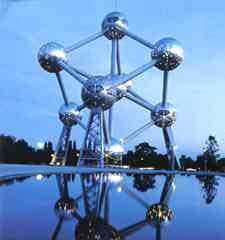
The next day I took them to the newly refurbished Atomium. Cynthia and I stood at its base and admired the big shiny balls for some time. It would have been churlish not to go inside and we wound our way from one sphere to another, feeling like characters in an episode of Dr Who. Angus, who is frightfullly clever, if a bit mad, pointed out that the Atomium is in fact a cube stood on one corner. And there was me thinking it was just a load of balls.

After a snifter at the Café Metropole on place De Brouckère, where it was warm enough to sit outside and do some people-watching, Angus announced that he was hungry again. We had to stop at a waffle van and stuff a gaufre au chocolat down him to keep him quiet.

In the evening we headed to Chez Léon, that most Bruxellois of brasseries. The food is always reliable, especially if you like mussels, but I love to sit and watch the manageress in action. Madame is always immaculately coiffed and smiling serenely, but presides over the maze-like restaurant with a gimlet eye and total control. She knows exactly who’s had what and which cutlery they used. A woman after my own heart. Angus had mussels in white wine sauce, Cynthia had sole, and I had salmon. All dishes were simple, fresh and beautifully cooked. And eaten with the correct cutlery.

We finished the evening with digestifs in Le Roy d’Espagne on the Grand’ Place, that peculiar pub where the lamps have pigs’ bladders hanging off them. I didn’t dare ask why. Angus, who of course was hungry again, had a Dame Blanche. With big shiny balls squeezed between a Blonde de Bruges and a Dame Blanche, I think most chaps would call that a good weekend.

Somewhere for the Weekend


My new gentleman friend, Baron Heinrich von Fuchs-Langezeit, proposed a weekend break. It would have been a romantic gesture, had he not let slip that he had a golfing appointment with a couple of old mates from Wuppertal. Oh well, I thought, beggars can't be choosers. We flew to Málaga from Brussels on Virgin Express for 220 euros. The two and a half hour flight was uneventful, just remember to take your own sandwiches! Or pay 4 euros for a soggy ham roll.

Marbella, 45 minutes drive from Málaga, is extremely swanky, and if you can afford to stay there, it’s really very pleasant. You really get a much better class of ghastly tourist there. We dined in a delightful courtyard restaurant near Plaza de las Naranjas, which is more or less the town square of Marbella. Thankfully the designer shops close early there, as my plastic would have gone into meltdown. Nearby Puerto Banus is where the mega-rich park their yachts while they go to have their gold cards polished. Heinrich marched around the harbour sporting his nautical cap and cravat, and staring out to sea through his one good eye. As we sat at a harbourside cafe having a well-earned libation, I thought I heard him say "Sink the Bismarck", but it turned out to be "I zink ze beer's muck". His Prussian accent is very attractive, but occasionally quite impenetrable.

Mijas is a former Arab fortress and beautiful “pueblo blanco” clinging to the hills above Fuengirola. Although it can be overrun with tourists in high season, it is a delightful little place with a shrine to the Virgen de la Pena, a sort of large Barbie doll with an impressive wardrobe who lives in a grotto and is paraded through the town occasionally. Perhaps one day she will be introduced to the Mannequin Pis and start a clothing chain for 2-foot tall public figures. Mijas also has the smallest bullring in Andalucía, which perches right at the top of the town, ensuring that the bulls will be nice and tired by the time they get to do battle with the toreadors. Viewpoints over the coast are liberally scattered along the old Arab ramparts and the vista over Fuengirola and the Med is quite spectacular. We ate dinner at the very posh La Alcazaba with its panoramic views. I must recommend the “leg of baby lamb” which turned out to be just that – a whole leg of a very baby lamb, in fact I doubt it had a chance to utter “baa” before it was bundled into the oven. The meat was succulent and delicately tender like baby suckling pig, the animal not yet old enough to have developed the sheepy taste of older lamb.

I must say the Spanish take their food even more seriously than the French, if that is possible. As all the shops shut between 2 and 5, you have no choice but to have lunch. And that, readers, is exactly what we did most days. In Fuengirola, “Fish Alley” as it is known to the native Brits runs parallel to the paséo (seafront) and offers a plethora of eateries, all offering roughly the same selection of fresh fish, pasta, meat and eggy dishes at roughly the same prices – a standard lunchtime 3-course menu for between 8 and 10 euros. To find the more local restaurants and tapas bars head away from the sea until the menus are only in Spanish.

Heinrich went off for a round of golf or three with an old friend who had retired to the Costa del Sol after a spot of bother with the Munich constabulary, so I decided to be a culture vulture for a couple of days. The Talgo train to Córdoba follows a scenic route through citrus groves in the foothills of the Sierra Nevada, through the spectacular El Chorro gorge and across the olive groves on the high plains to one of the three great Moorish cities of Andalucia (the other two being, as you all know, Granada and Seville). I stayed in the Hotel Lola on Calle Romero (
www.hotelconencantolola.com) in the old town (60 euros a night, lovely olde-worlde decor but don’t take a cat as there’s no room to swing it). If you like a bit of nightlife you might prefer to stay nearer to the newer part of town where the cafés and shops are, around Plaza Tendillas or the Avenida del Gran Capitan, as you’d never find your way back through the old town after dark. Built by the Moors, it resembles an Arab casbah, a maze-like warren of narrow winding streets, some not even wide enough for two people to pass. Some are just about wide enough for a car. Córdoban drivers must be the most careful motorists in Spain.

The main attraction in Córdoba is the Mesquita, built first as a mosque, then converted to a cathedral after the Moors were driven out of Spain. Don’t ask me for dates, I left my guide book on the train. The interior of the Mesquita is architectural prozac. The repetition of the graceful archways, which are meant to recall a palm grove, have a soothing effect on the visitor. There are no chairs, no pulpits, no statues, no Heinrich, nothing to distract the eye. Just space and arches. I was almost drifting off into a reverie where Omar Sharif was beckoning to me with bedroom eyes over his Bedouin scarf, when a large group of German tourists came in and their guide started barking the history of the building in a booming voice, so I threw Omar a regretful look and glided out into the midday sun.

Córdoba old town is full of typically Andalucian patios with mosaic tiles and fountains, many of which are restaurants, but not all of which are good. Any restaurant in the same building as a “hostal” will be cheap but unspectacular. You’ll get your standard gazpacho and a soggy paella for under 10 euros, but if you want to go more upmarket, try El Caballo Rojo right opposite the main entrance to the Mesquita. It has air conditioning, snooty waiters in pearl-grey neckties, a complimentary Fino and nibbles before you order, and a sweet trolley to die for. I tucked into Andalucian asparagus with prawns, followed by sautéed lamb’s kidneys and a half bottle of Crianza 2000, whilst idly observing an American family nearby who seemed to have Scott Evil for a son. As they patiently discussed the pros and cons of time-travel with the obnoxious little creep, I smiled happily, as only those without children can. With a crème caramel and a café solo, my meal came to 47 euros, and I sailed back to Hotel Lola in a slightly alcoholic haze on Omar’s arm.

I wouldn’t suggest trying to do all these places in a weekend, but if you hire a car you could probably manage at least a couple, and if you were really determined you might try and do the Big Three (Cordoba, Granada and Seville). Málaga, however, is a perfectly pleasant place to while away a weekend. I spent the best part of a day there, exploring the traditional town centre with some nice designer shops. The Cathedral is worth a visit, but the Picasso Museum was, I’m sorry to say, a waste of time, unless you are a real Picasso fanatic. It contains a few rooms of unspectacular scribblings, and not one painting which has featured in any art book I’ve ever seen (not that I’ve seen many). Of course all his best stuff is in Paris or Madrid. Spend the 8 euros instead in El Pimpi, the bodega just round the corner, where you can nibble on selections of cured meats or a plate of “tostas” – slices of toasted baguette spread with various delicious toppings – accompanied by a refreshing glass of cerveza. Malaga has plenty of nightlife and culture to offer, with clubs, theatres and concerts, and of course the obligatory flamenco tablao.

Loaded down with packets of Serrano ham and bottles of extra-virgin olive oil from the airport duty-free shop, we returned to BXL on Mr Branson’s excellent flying contraption where we were royally welcomed by the Hornblowers and their delightful grandchildren, Hermione and Hepzibah, who were delighted with the castanets but kept us up half the night with the clacking.


Sunday, March 26

Small World

I met up with Vi Hornblower for a GNO (Girls’ Night Out) recently. We met at Le Jardin de Nicolas, by Montgoméry metro, which is a pleasant little spot for an aperitif or a cocktail, although Nicolas’ garden wasn’t open due to the brass monkey temperatures. Vi arrived en catastrophe, reapplying Max Factor’s Harem Nights hi-gloss lippy whilst muttering about having to call Pawel out to give her hot pipes a seeing-to. I ordered her a Harvey Wallbanger, she looked as if she needed one. She was wielding a gigantic handbag recently acquired on a shopping expedition to New York. Everything’s bigger in the States.

We moved on to “Le Monde est Petit”, a discreet little place on the corner of rue des Bataves (Tel. : 02.732.44.34) just a little way down the Avenue de Tervuren towards Mérode. Non-smokers will like this place, the front room is smoke-free, but Vi was gagging for a Sobranie so we sat in the “salon” at the back, which has comfy chairs under a Moroccan canopy and is the perfect place for romantic trysts. Or conversations of the type Vi and I have. After a general overview and subsequent trashing of various gentlemen friends, we covered sex tourism for women, bra sizes, and the personal proclivities of the Liberal Democrats.

“Le Monde est Petit” has a blackboard menu, although is a fairly upmarket establishment in every other respect. The kitchen is situated between the front and back rooms and the chef is on public view, so has to keep his whites clean and not spit in the soup. The lady who took our order and served the food was in a state of permanent excitement (as well as a fairly advanced state of pregnancy), bursting into giggles after each visit to our table. She must have been listening in to our conversation.

Vi kicked off with Croquettes de Crevettes (about €9), an old Belgian favourite, although served here in a modern three-panel rectangular plate, which a large croquette at each end and a bit of arty salad in the middle. For main course Vi had the magret de canard, and I had cotelettes d’agneau (about €14 each). Le Monde was not the only thing that was Petit, the portions were fairly nouvelle, but exquisitely presented on large square white plates. My cotelettes d’agneau were arranged like the sails on a little boat made from a slice of aubergine with baby courgettes, baby tomatoes and other vegetable artfully arranged on top. We had a bottle of the house red, a perfectly respectable Vin du Pays d’Oc that wouldn’t set the world on fire but neither would it burn your wallet at 16 euros – and they charge by the centimetre, so if you don’t finish the bottle you don’t pay for it all. Fat chance of that at our table, but always useful to know.

For pudding Vi and I abandoned our overly ambitious plan to share a Crème Brulée aux Pruneaux, and had one each (about €6). It had a fruity flavour and the caramel glaze was as crisp as the ice on Ixelles ponds, and cracked beautifully when bashed with the spoon. The after-dinner coffee was served with a plateful of chocolate Neapolitans. I pretended not to see Vi shove a handful into her copious handbag. The final damage was around 90 euros for two. Not for big hungry truck-drivers, but ideal for non-smokers or people having an illicit liaison, although remember that Le Monde est Petit translates as “small world”. Your dirty little secret might end up on Daphne’s blog.